Published on 2026-02-19
A practical playbook for product owners and developers: keep UX smooth, stop automated abuse, and measure what changes.
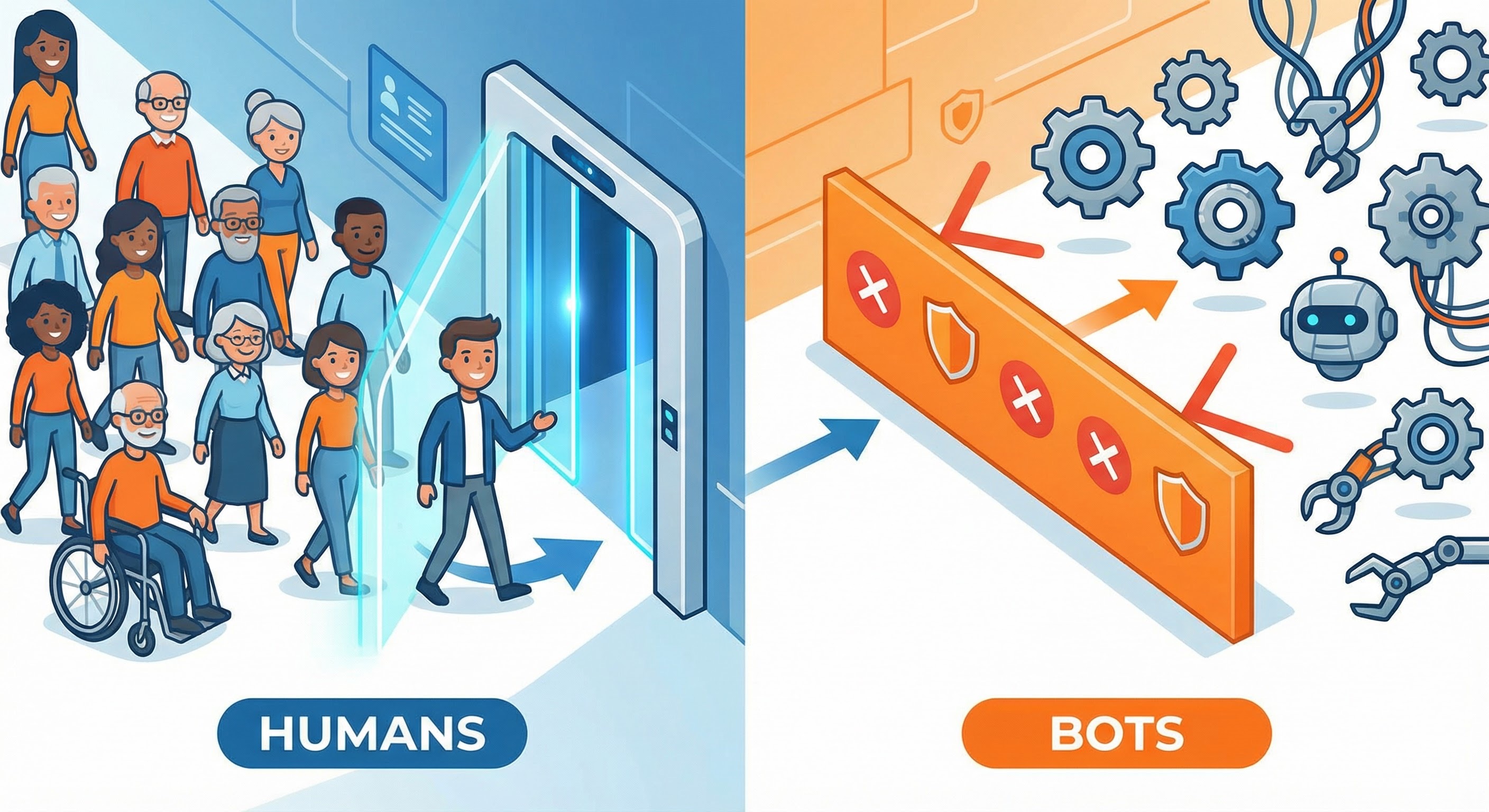
“Invisible CAPTCHA” usually means background risk scoring: the user does their thing, and your site quietly decides whether the session looks human.
Google’s reCAPTCHA v3 popularised this approach by returning a score (0.0–1.0) per interaction, which you’re expected to use to allow, step up, or block on the server side (Google docs). That’s useful—but it also shifts a lot of judgement (and tuning) onto your team.
If you’re a product owner or developer looking for an invisible captcha alternative, aim for the same “mostly silent” UX, with clearer controls, better measurement, and fewer surprises.
Primary keywords: invisible captcha alternative, invisible CAPTCHA
Secondary keywords: bot prevention, risk-based verification, bot detection, CAPTCHA alternative
Most teams aren’t chasing “no UI” for its own sake. They want bot protection that doesn’t get in the way of sign-ups, logins, and checkout.
In practice, the requirements look like this:
If you take one idea from this post, make it this: the best “invisible” approach is rarely 100% invisible.
Instead, use risk-based verification to keep 95–99% of traffic smooth, and reserve step-ups for the sessions that deserve extra scrutiny. This aligns with how modern automated abuse works (credential stuffing, fake account creation, scraping, promo abuse)—which OWASP classifies as “automated threats” against normal application functionality (OWASP Automated Threats project).
This is the pattern we see work well across product funnels:
For developers, this keeps logic tidy: one “risk gate” per endpoint, one decision returned, and clean metrics.
Invisible checks shine on high-volume, low-tolerance steps where friction kills conversion.
Good fits:
Less ideal as a solo defence:
For the high-value actions, consider adding phishing-resistant authentication like passkeys/WebAuthn as a step-up. WebAuthn is the W3C standard API for public-key credentials in the browser (W3C WebAuthn spec). It’s not a replacement for bot detection everywhere, but it’s excellent when the risk is real.
Imagine a SaaS product with a free trial:
A risk-based “invisible CAPTCHA alternative” approach:
The result: real users keep flowing, while automated sign-ups get expensive and noisy for attackers.
A lot of tools claim to be “invisible”. Here’s how to separate marketing from something you can run in production.
Humans Only is an invisible captcha alternative built for teams who want strong bot prevention while keeping the experience pleasant for real users.
It’s fast (typically under 2 seconds), privacy-first (zero tracking), and designed for drop-in integration—plus real-time analytics so you can see what changed after launch.
If you’re replacing an invisible CAPTCHA setup (or considering one), the goal isn’t “no interaction ever”. The goal is risk-based verification that stays quiet when things look normal, and steps up only when traffic looks automated.
An invisible CAPTCHA alternative should give you the same smooth UX—without turning bot defence into a guessing game.
Build (or choose) a system with a clear risk gate, three outcomes (allow/step-up/block), and metrics you can tune. That’s how you Stop Bots, Welcome Humans—without slowing down the people you actually want.
We use cookies to improve your experience and anonymously analyze usage.